
Streaming dramas online has become one of the most popular ways to enjoy entertainment today. Whether you are watching Korean dramas, Chinese series, or Thai shows, streaming offers instant access to a wide range of content.
However, one of the most frustrating problems viewers face is buffering.
You press play, and instead of enjoying your favorite drama, you see the loading circle spinning again and again. This can ruin the entire viewing experience, especially during important scenes.
If you are tired of constant buffering, this guide will show you exactly how to fix it using simple and effective methods.
What Causes Buffering When Streaming
Before fixing the problem, it is important to understand why buffering happens.
Buffering occurs when your internet connection cannot load video data fast enough. The video pauses to load more content, causing interruptions.
Common Causes:
- Slow internet speed
- Weak Wi-Fi signal
- High video quality settings
- Server overload
- Background apps using bandwidth
What are the common problems that most people are facing?
In addition to these technical causes, many users also face everyday challenges that contribute to buffering problems without realizing it. One of the most common issues is using outdated devices. Older smartphones, tablets, or computers may not have enough processing power or memory to handle modern streaming platforms efficiently. As a result, even if the internet connection is stable, the device itself may struggle to load and play videos smoothly.
Another frequent problem is poor network management at home. Many households connect multiple devices to the same Wi-Fi network, including phones, laptops, smart TVs, and gaming consoles. When all these devices are active at the same time, they compete for bandwidth, which can significantly slow down streaming performance. This is especially noticeable during peak hours when everyone is online.
Users also often overlook the importance of router quality and placement. A low-quality or outdated router may not be able to deliver strong and consistent signals throughout the home. Additionally, placing the router in a corner, behind walls, or near electronic interference can weaken the signal, leading to buffering issues even at short distances.
Another common issue is ignoring software updates. Streaming apps, browsers, and operating systems regularly release updates to improve performance and fix bugs. When users delay or skip these updates, they may experience compatibility issues or slower performance, which can contribute to buffering.
Many people also fall into the habit of opening too many tabs or apps at once. This not only consumes internet bandwidth but also uses up system resources such as RAM and CPU power. As a result, the device becomes slower, and streaming quality is affected.
Lastly, unrealistic expectations can also play a role. Some users expect to stream high-definition or even 4K videos on slow or unstable internet connections. Without adjusting video quality settings, buffering becomes unavoidable.
Understanding these common problems can help users take better control of their streaming experience. By making small adjustments in device usage, network management, and settings, it is possible to reduce buffering and enjoy smoother playback.
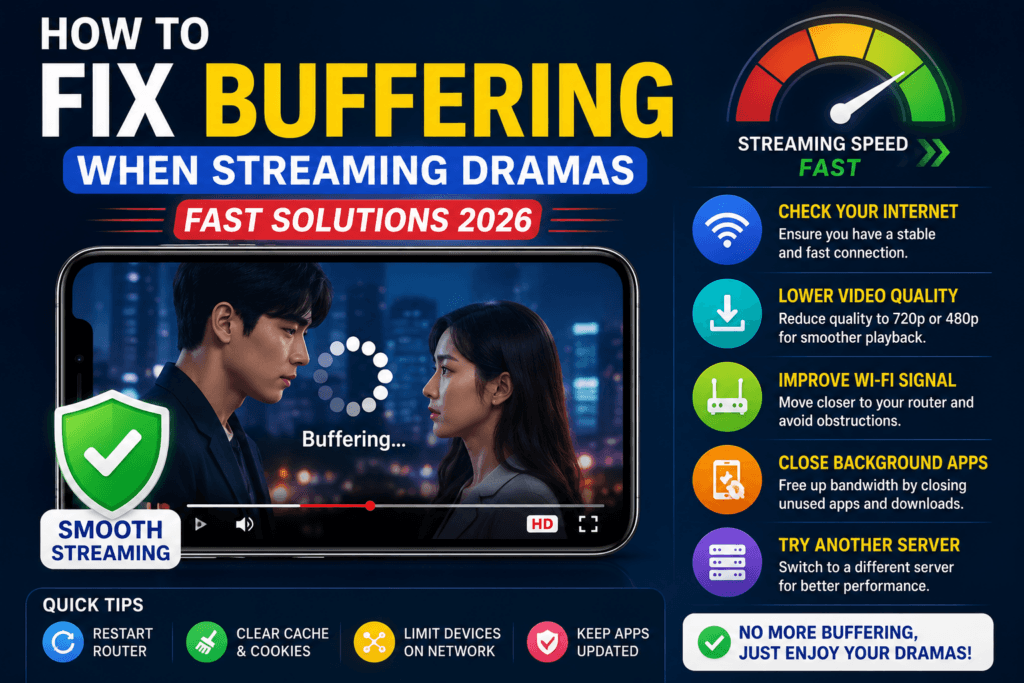
Step 1: Check Your Internet Speed
Your internet speed is the most important factor in streaming performance.
Recommended Speeds:
- 480p: at least 3 Mbps
- 720p: at least 5 Mbps
- 1080p: at least 10 Mbps
What You Can Do:
- Run a speed test
- Restart your router
- Contact your internet provider if speed is too low
Step 2: Lower Video Quality
Many users try to watch videos in high quality even when their internet cannot support it.
Solution:
- Switch from 1080p to 720p or 480p
Lowering quality reduces data usage and helps videos load faster.
Step 3: Move Closer to Your Wi-Fi Router
Distance from your router affects signal strength.
Fix:
- Sit closer to the router
- Avoid walls or obstacles
- Place your router in an open space
A stronger signal improves streaming stability.
Step 4: Close Background Apps
Apps running in the background use internet bandwidth.
What to Do:
- Close unused apps
- Stop downloads or updates
- Limit devices connected to your network
This ensures more bandwidth for streaming.
Step 5: Use a Wired Connection (If Possible)
Wi-Fi is convenient, but not always stable.
Better Option:
- Use an Ethernet cable
A wired connection provides faster and more stable internet.
Step 6: Restart Your Router
Sometimes your router needs a reset.
Steps:
- Turn off your router
- Wait 30 seconds
- Turn it back on
This can fix many temporary network issues.
Step 7: Choose a Better Streaming Server
Many streaming websites offer multiple servers.
What to Do:
- Switch to another server option
- Test which one loads faster
Different servers have different speeds and loads.
Step 8: Clear Browser Cache
Cache files can slow down performance.
How to Fix:
- Go to browser settings
- Clear cache and cookies
This helps your browser load content more efficiently.
Step 9: Use a Lightweight Browser or App
Heavy browsers or apps can slow down streaming.
Try:
- Google Chrome
- Microsoft Edge
Make sure your browser is updated.
Step 10: Limit Network Usage
If multiple people are using the same internet, speed can drop.
Tips:
- Avoid streaming during peak hours
- Ask others to limit heavy usage
This improves your available bandwidth.
Step 11: Use Data Saver Mode
Some apps have built-in data-saving features.
Benefits:
- Reduces video quality automatically
- Saves bandwidth
- Minimizes buffering
Enable this option if available.
Step 12: Check for ISP Throttling
Some internet providers slow down streaming speeds.
Signs:
- Streaming is slow but browsing is fast
Solution:
- Contact your ISP
- Try different streaming platforms
Step 13: Use a Faster DNS
DNS settings can affect connection speed.
Popular Options:
- Google DNS
- Cloudflare DNS
Switching DNS can improve loading time.
Step 14: Update Your Device
Outdated devices may struggle with modern streaming.
What to Do:
- Update your system
- Close unused apps
- Restart your device
Better performance leads to smoother playback.
Step 15: Download Instead of Streaming
If buffering continues, consider downloading episodes.
Benefits:
- No interruptions
- Watch offline
- Better control over quality
This is a reliable solution for unstable internet.
Common Mistakes to Avoid
Many users unknowingly make mistakes that cause buffering.
Avoid These:
- Watching in HD on slow internet
- Using too many devices on one network
- Ignoring updates
- Using low-quality routers
FAQ (Frequently Asked Questions)
Why does buffering happen even with good internet?
It could be due to server issues or network congestion.
Is Wi-Fi better than mobile data?
Wi-Fi is usually more stable, but it depends on your setup.
Can buffering be completely eliminated?
Not always, but it can be reduced significantly.
Does video quality affect buffering?
Yes, higher quality requires more bandwidth.
Final Thoughts
Buffering can be frustrating, but it is usually easy to fix with the right approach.
Most issues come from internet speed, device performance, or streaming settings. By adjusting these factors, you can greatly improve your viewing experience.
Simple steps like lowering video quality, closing background apps, and choosing better servers can make a big difference.
If your connection is unstable, downloading episodes may be the best option.
Follow the steps in this guide and enjoy smooth, uninterrupted drama streaming in 2026.
